



Every month, we speak with founders, CEOs, and marketing leaders who are investing heavily in marketing but struggling to explain one thing.
“Why isn’t our marketing generating predictable growth?”
The conversation is remarkably similar across industries.
A SaaS company has a healthy advertising budget, but customer acquisition costs continue to increase.
A B2B technology business ranks well on Google, yet inbound enquiries remain inconsistent.
A startup is active across LinkedIn, Google Ads, email marketing, webinars, and SEO, but every channel operates independently with no clear connection to revenue.
The common assumption is that another campaign, another platform, or another agency will solve the problem.
In reality, the issue is rarely the channel.
It’s the absence of a growth marketing strategy.
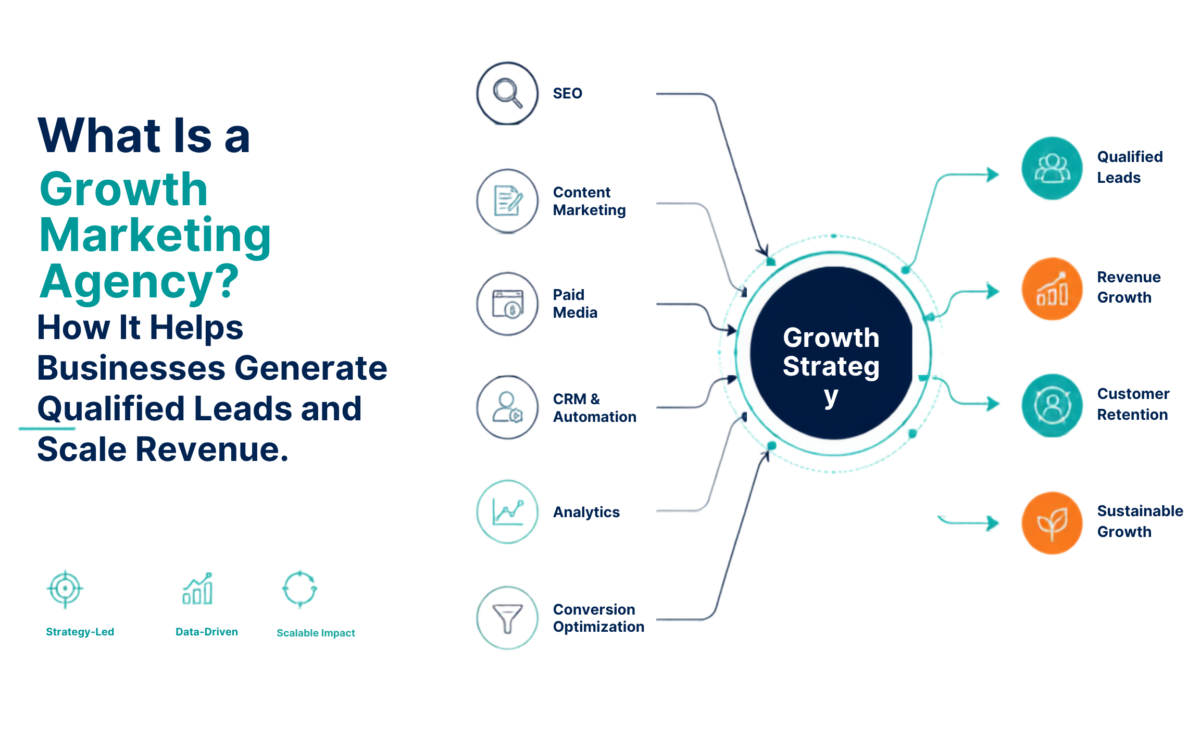
Marketing activities often evolve in silos. SEO focuses on rankings, paid advertising optimizes clicks, content teams publish blogs, CRM platforms send emails, and sales teams pursue leads independently. Each initiative may perform reasonably well on its own, but without a unified strategy, businesses struggle to build a predictable pipeline.
This is exactly where a growth marketing agency creates value.
Unlike traditional agencies that specialize in individual services, growth marketing agencies focus on the complete customer journey. Every marketing activity is measured against one objective: sustainable business growth.
At Digital Marketers India, we frequently work with businesses after they’ve already invested in multiple marketing initiatives. They aren’t looking for another vendor to manage campaigns. They’re looking for a strategic partner who can connect marketing, sales, customer experience, and analytics into one scalable growth engine.
The conversation usually changes from:
“Can you improve our SEO?”
to
“How do we generate more qualified leads without increasing our marketing budget every quarter?”
That’s a very different challenge.
And it requires a very different approach.
According to HubSpot’s State of Marketing Report, marketers continue to prioritize lead generation and customer acquisition as their primary objectives, while demonstrating ROI remains one of the biggest challenges for marketing teams. These priorities reinforce why businesses are shifting from channel-specific marketing to integrated growth strategies.
As markets become more competitive and customer journeys more complex, businesses need more than execution. They need a strategy that aligns every marketing activity with measurable business outcomes.
That’s the role of a modern B2B growth marketing agency.
In this guide, we’ll explain what growth marketing really means, how a growth marketing agency differs from a traditional digital marketing company, what you should expect from a strategic growth partner, and how to choose the right agency to support your business goals.
What Is Growth Marketing?
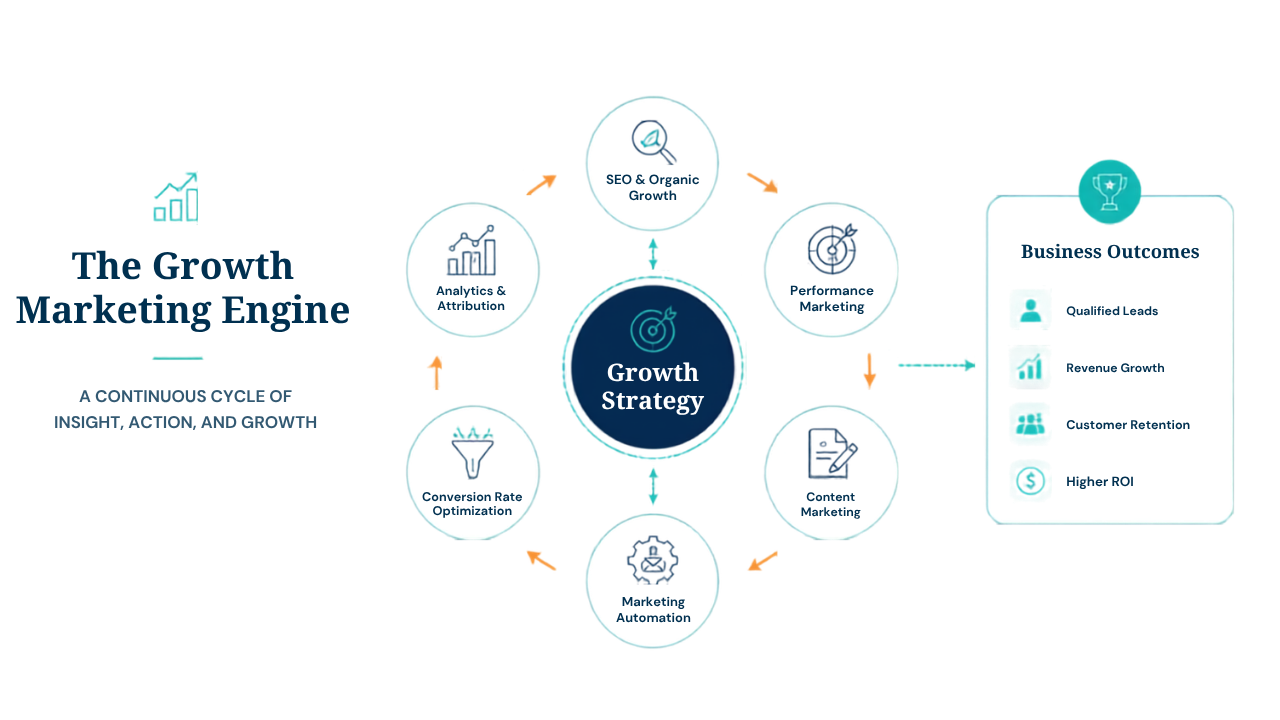
This type of tailored marketing is a data-driven approach to marketing that focuses on acquiring, converting, retaining, and expanding customers through continuous testing, optimization, and cross-channel strategies. Unlike traditional marketing, growth marketing measures success by business outcomes such as qualified leads, customer acquisition, revenue growth, and customer lifetime value rather than campaign metrics alone.
Traditional marketing often asks:
“How do we generate more traffic?”
Growth marketing asks:
“How do we generate sustainable business growth?”
That difference influences every marketing decision.
Instead of optimizing individual campaigns, growth marketers optimize the entire customer journey, from the first interaction with your brand to repeat purchases and customer advocacy.
Growth marketing combines multiple disciplines, including:
- Search engine optimization (SEO)
- Performance marketing
- Conversion rate optimization (CRO)
- Content marketing
- Marketing automation
- CRM strategy
- Email marketing
- Landing page optimization
- Analytics and attribution
- Customer retention and lifecycle marketing
Rather than treating these as separate services, they work together as one integrated system.
For Example
Imagine two SaaS companies selling the same product.
The first company invests in Google Ads to generate demo requests. Their SEO agency focuses on keyword rankings, while the content team publishes educational blogs. Although each channel performs reasonably well, they’re managed independently, making it difficult to understand which activities contribute most to revenue.
The second company adopts a growth marketing approach.
SEO targets high-intent keywords that attract decision-makers. Paid advertising supports organic campaigns by promoting high-converting landing pages. Marketing automation nurtures prospects based on behaviour, while CRM data helps prioritize sales-qualified leads. Every campaign is measured against pipeline contribution, customer acquisition cost, and lifetime value.
Both companies invest in marketing.
Only one has built a growth engine.
Key Characteristics of Growth Marketing
Growth marketing differs from traditional digital marketing because it prioritizes continuous improvement rather than one-time campaign execution.
The most successful growth marketing agencies typically focus on:
- Understanding the complete customer journey.
- Using data to guide every marketing decision.
- Running ongoing experiments to improve performance.
- Aligning marketing with sales and customer success.
- Measuring qualified leads and revenue instead of vanity metrics.
- Continuously improving customer acquisition costs and conversion rates.
At Digital Marketers India, we often remind clients that growth marketing isn’t another marketing channel.
It’s the framework that connects every channel.
Key Takeaways
If you’re new to growth marketing, remember these principles before moving further.
- Growth marketing focuses on business growth, not just marketing activities.
- It combines SEO, paid media, content, CRM, automation, analytics, and conversion optimization into one unified strategy.
- Success is measured by qualified leads, customer acquisition, revenue, and customer lifetime value.
- The best growth marketing agencies continuously test, measure, and optimize rather than relying on fixed campaigns.
- Businesses that connect their marketing channels generally achieve stronger long-term performance than those managing each channel independently.
Why Are More Businesses Hiring a Growth Marketing Agency Instead of a Traditional Digital Marketing Agency?
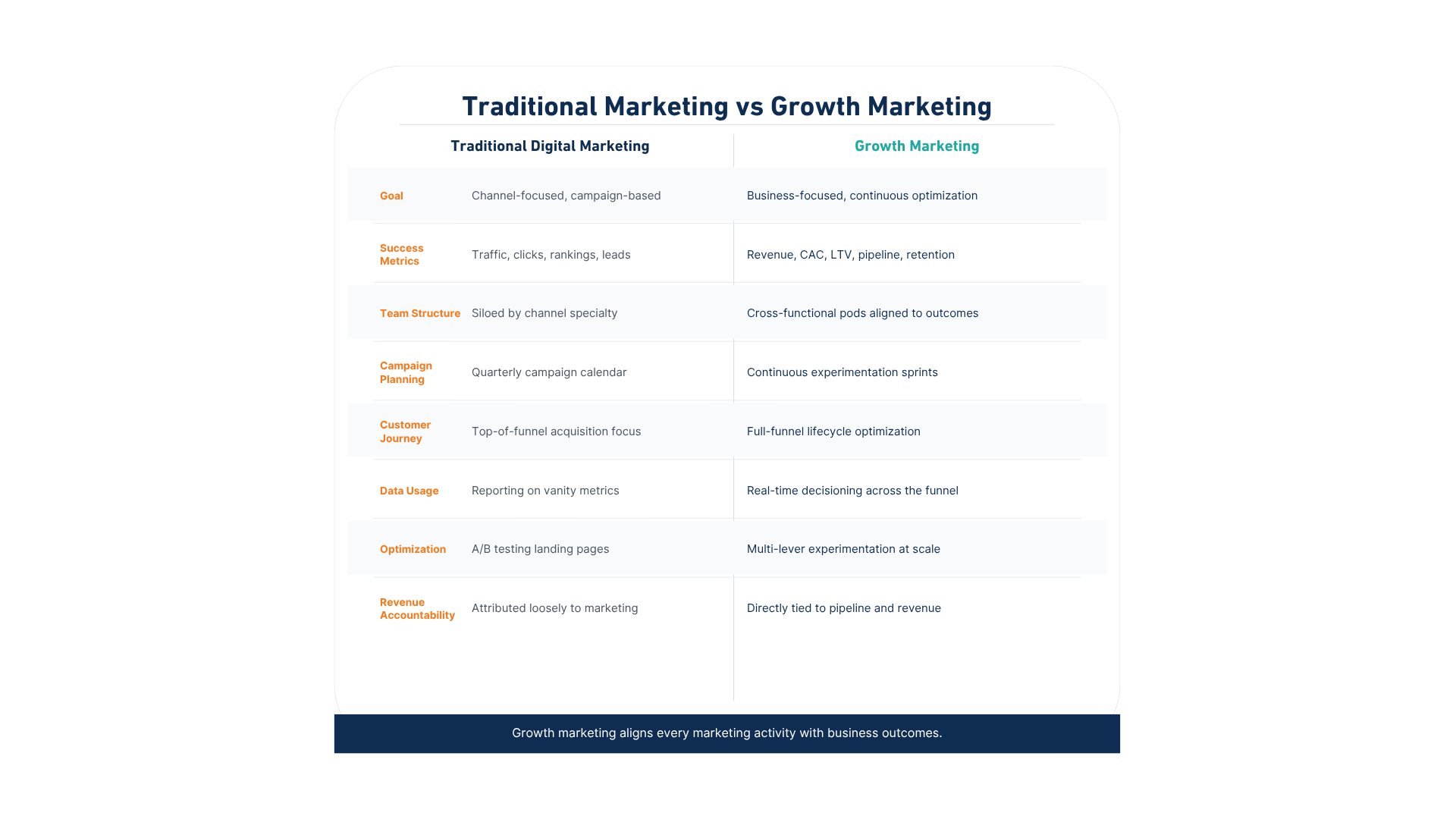
Businesses increasingly hire a growth marketing agency because they need strategic guidance, measurable ROI, and integrated execution rather than isolated marketing services.
This shift is happening because business leaders have become more sophisticated in how they evaluate marketing performance.
Ten years ago, agencies were often measured by rankings, impressions, or website traffic.
Today, founders and CEOs ask different questions.
- How many qualified leads did marketing generate?
- What is our customer acquisition cost?
- Which channels contribute most to revenue?
- How can we scale without proportionally increasing marketing spend?
- Which activities should we stop investing in?
These questions cannot be answered by SEO, paid advertising, or social media in isolation.
They require a growth strategy.
During our discovery workshops, we often map a client’s entire customer journey before recommending any marketing activities.
Sometimes the problem isn’t lead generation.
It’s lead qualification.
Sometimes it isn’t website traffic.
It’s poor conversion rates.
Sometimes marketing is performing well, but sales processes create unnecessary friction.
Without understanding the complete system, it’s easy to optimize the wrong metric.
That’s one of the biggest differences between a digital marketing growth agency and a traditional marketing agency.
A traditional agency often starts with a service.
A growth marketing agency starts with a business objective.
What Does a Growth Marketing Agency Actually Do?
A growth marketing agency helps businesses build a predictable and scalable growth engine by combining strategy, execution, analytics, experimentation, and optimization across the entire customer journey. Instead of managing isolated marketing activities, the agency aligns every initiative with measurable business outcomes such as qualified leads, customer acquisition, revenue, customer retention, and customer lifetime value.
Many businesses initially approach us looking for a specific service.
Some ask for SEO because organic traffic has declined.
Others want Google Ads because lead generation has slowed.
Some believe marketing automation or LinkedIn outreach will solve their pipeline challenges.
While these services may be necessary, they’re rarely the root solution.
At Digital Marketers India, we begin by understanding how the business grows today.
We typically ask questions such as:
- Where do your best customers come from?
- Which marketing channels generate qualified leads?
- How long is your sales cycle?
- Where are prospects dropping out of the buying journey?
- Which marketing activities directly influence revenue?
The answers often reveal that the business doesn’t have a marketing problem.
It has a growth system problem.
That’s where growth marketing services become valuable.
Instead of optimizing individual channels, we optimize how those channels work together.
How Does a Growth Marketing Agency Build a Growth Strategy?
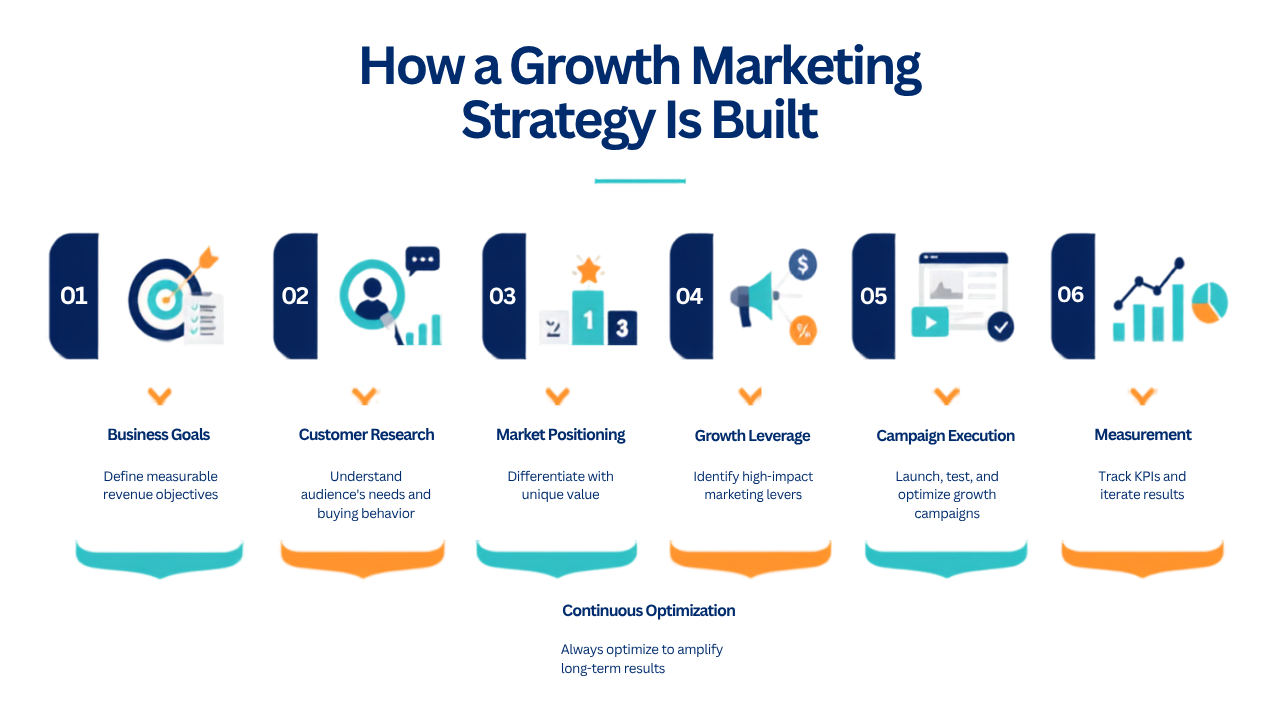
A successful growth strategy starts with business objectives, not marketing channels. The best growth marketing agencies first understand your customers, buying journey, revenue goals, and existing performance before recommending tactics.
One mistake we see repeatedly is businesses choosing marketing tactics before defining a growth strategy.
For example:
- “Let’s invest in SEO.”
- “We need LinkedIn Ads.”
- “Let’s hire someone for email marketing.”
Those decisions may be correct.
But without understanding why those channels are needed and how they contribute to growth, marketing quickly becomes fragmented.
At Digital Marketers India, every engagement starts with a strategic discovery process before any execution begins.
A typical growth marketing strategy includes:
| Stage | Questions We Help Answer |
| Business Goals | What does success look like over the next 12-24 months? |
| Ideal Customer Profile | Who are your most profitable customers? |
| Market Positioning | Why should buyers choose you instead of competitors? |
| Customer Journey | How do prospects discover, evaluate, and purchase? |
| Marketing Channels | Which channels influence each buying stage? |
| Funnel Analysis | Where are leads dropping out? |
| Measurement Framework | Which KPIs actually matter? |
| Experimentation Roadmap | What should we test first to accelerate growth? |
Only after answering these questions do we recommend specific tactics.
This approach helps businesses avoid investing in marketing activities that don’t support their long-term growth objectives.
For Example
One software company approached us wanting to improve Google Ads performance because their cost per lead had nearly doubled over twelve months.
Instead of immediately restructuring campaigns, we reviewed their complete customer journey.
The advertising campaigns weren’t the problem.
Traffic was landing on generic product pages that lacked industry-specific messaging, customer success stories, implementation details, and clear calls-to-action.
Rather than increasing advertising spend, we improved the landing pages, aligned messaging with buyer intent, strengthened nurturing workflows, and introduced clearer qualification paths.
Within a few months, lead quality improved without significantly increasing advertising investment.
Sometimes growth comes from improving the system rather than spending more money.
What Role Does a Growth Marketing Agency Play in B2B Growth?
A B2B growth marketing agency helps businesses generate predictable demand by aligning marketing activities with complex buying journeys, long sales cycles, and revenue objectives.
B2B purchasing decisions rarely happen after a single interaction.
A potential customer may:
- Read several blog articles.
- Download a resource.
- Attend a webinar.
- Compare multiple vendors.
- Speak with different stakeholders internally.
- Return several weeks later to request a proposal.
Marketing must support every one of those touchpoints.
Unlike B2C businesses, B2B organizations often sell higher-value solutions with longer decision-making cycles.
That changes how marketing should be measured.
Instead of focusing only on traffic or clicks, businesses should monitor:
- Marketing Qualified Leads (MQLs)
- Sales Qualified Leads (SQLs)
- Opportunity creation
- Sales pipeline influenced
- Customer acquisition cost
- Revenue contribution
- Customer lifetime value
This is why many businesses now prefer working with a B2B growth marketing agency instead of hiring multiple specialist agencies.
Every activity contributes to the same business objective.
What We Recommend to Our B2B Clients
Across many B2B engagements, we’ve found that the strongest growth usually comes from combining several initiatives rather than relying on one channel.
For example:
- SEO attracts buyers actively researching solutions.
- LinkedIn builds credibility with decision-makers.
- Paid media accelerates demand generation.
- Email nurturing keeps prospects engaged.
- CRM automation ensures sales teams follow up consistently.
- Content marketing answers buying questions before prospects speak to sales.
When these initiatives operate together, marketing becomes significantly more predictable.
How Does Growth Marketing Help SaaS Companies Scale Faster?
A B2B SaaS growth marketing agency helps software companies reduce customer acquisition costs, increase product adoption, improve retention, and build predictable recurring revenue through continuous optimization.
SaaS businesses face unique challenges.
Growth isn’t measured simply by acquiring new customers.
Success also depends on:
- Trial-to-paid conversion rates
- Product adoption
- Customer retention
- Expansion revenue
- Monthly recurring revenue (MRR)
- Annual recurring revenue (ARR)
Because subscription businesses rely on recurring revenue, acquiring customers who quickly churn can become extremely expensive.
According to McKinsey & Company, companies that use customer analytics and personalization effectively can significantly improve acquisition, retention, and customer satisfaction, highlighting why data-driven optimization has become central to sustainable growth strategies.
Growth marketing addresses this challenge by optimizing every stage of the customer lifecycle.
SaaS Growth Example
Imagine two SaaS businesses acquiring 100 new trial users each month.
Company A focuses primarily on increasing advertising spend to attract more trials.
Company B improves onboarding emails, product education, in-app messaging, customer success workflows, and remarketing campaigns before increasing acquisition budgets.
Both companies may acquire the same number of users.
However, Company B converts more trials into paying customers while retaining them for longer.
The result is lower acquisition costs and stronger long-term profitability.
This is why successful growth marketing consultants don’t only ask:
“How do we generate more leads?”
They also ask:
“How do we help existing customers become more successful?”
Thinking Beyond Marketing Channels?
Businesses rarely achieve sustainable growth by improving one marketing channel in isolation. If you’re evaluating how SEO web marketing, paid media, CRM automation, content, and conversion optimization should work together, our team can help you identify the highest-impact opportunities before you invest further.
Book a complimentary growth strategy consultation with Digital Marketers India and receive practical recommendations tailored to your business objectives.
Key Takeaways
- A growth marketing agency focuses on business growth rather than isolated marketing activities.
- Strategy should always come before selecting marketing channels.
- The best growth marketing agencies optimize the complete customer journey, from awareness to customer retention.
- A B2B growth marketing agency aligns marketing with long sales cycles, pipeline generation, and revenue growth.
- A B2B SaaS growth marketing agency focuses on customer acquisition, activation, retention, and recurring revenue rather than lead volume alone.
- Sustainable growth comes from improving the entire marketing system, not just individual campaigns.
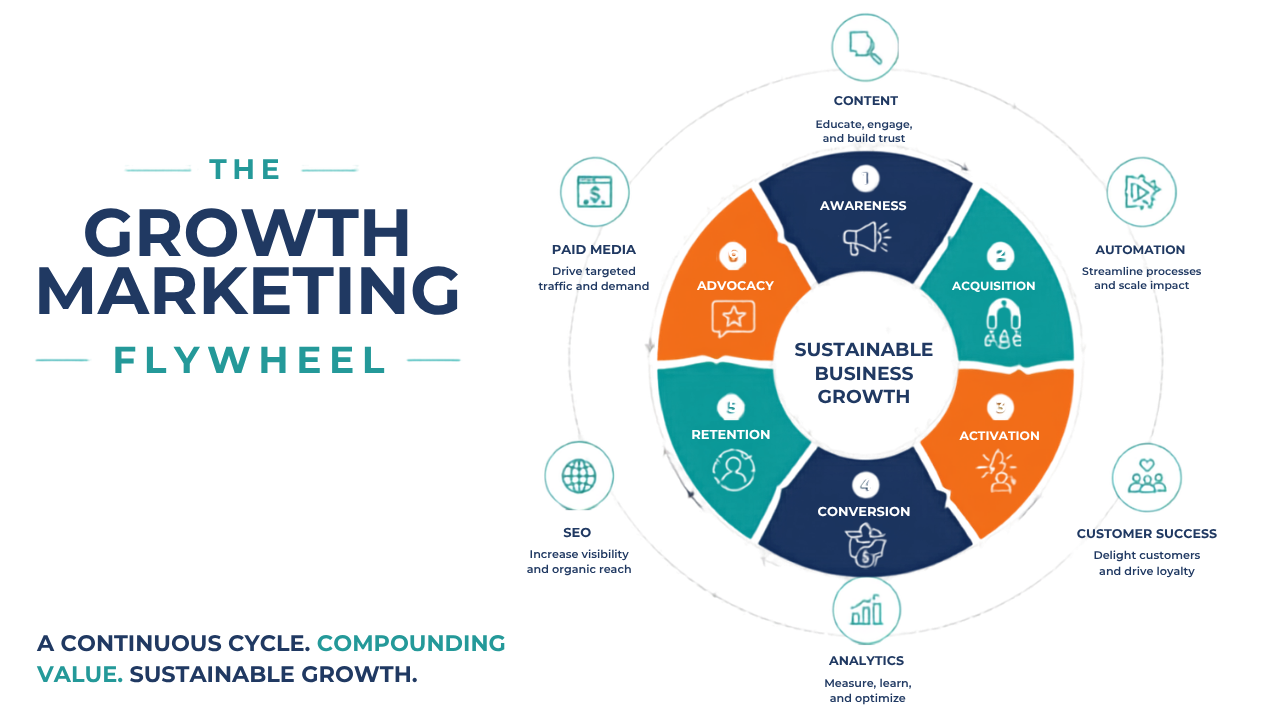
What Makes the Best Growth Marketing Agencies Different from Traditional Digital Marketing Companies?
The biggest difference isn’t the list of services an agency offers. It’s how they think.
Traditional digital marketing agencies are often hired to execute specific activities such as SEO, Google Ads, social media, or content creation. A growth-focused agency starts with a different question:
“What is preventing this business from growing?”
The answer isn’t always marketing.
Sometimes it’s positioning.
Sometimes it’s poor conversion rates.
Sometimes sales and marketing operate independently.
Sometimes the company is attracting the wrong audience altogether.
The best agencies don’t begin with tactics. They begin by understanding the business.
At Digital Marketers India, we’ve had discovery calls where clients expected us to recommend SEO or paid advertising. Instead, we advised them to revisit their messaging, redesign key landing pages, or improve lead qualification before increasing marketing spend.
That isn’t because marketing channels don’t matter.
It’s because scaling an inefficient system only creates more inefficiency.
How Can You Tell If an Agency Thinks Strategically?
One of the easiest ways to evaluate an agency is by paying attention to the questions they ask during your first conversation.
If the discussion immediately focuses on rankings, ad budgets, or social media posting frequency, they’re probably thinking about execution.
A strategic partner usually starts somewhere else.
They want to understand your business before recommending services.
Expect questions such as:
- What are your growth objectives over the next 12 months?
- Which products or services generate the highest margins?
- How does your current sales process work?
- Which customers are most profitable?
- Where do opportunities typically get lost?
- What has and hasn’t worked in the past?
Notice that none of these questions are about marketing channels.
They’re about understanding the business.
Only after that conversation should recommendations begin.
A Conversation We Have Quite Often as a Growth Marketing Agency
A founder recently told us,
“We’ve spent nearly three years changing agencies because everyone promises more leads.”
Our response surprised them.
Instead of discussing channels, we asked to see their sales process.
Within a few hours, it became obvious that marketing wasn’t the primary issue.
Leads were arriving.
Follow-up was inconsistent.
Marketing automation had never been configured properly.
Sales representatives responded at different times using different messaging.
Generating more leads wouldn’t have solved the problem.
Improving the customer journey did.
That project reinforced something we see repeatedly.
Growth isn’t created by adding another marketing activity.
It’s created by improving the entire system.
What Questions Should You Ask Before Hiring a Growth Marketing Partner?
Choosing an agency shouldn’t feel like buying a commodity.
You’re selecting a team that may influence your revenue for years.
Before making that decision, ask questions that reveal how they approach business problems.
Questions Worth Asking
- How do you define success for a client like us?
- How do you build a growth strategy?
- Which metrics do you report on regularly?
- How do you prioritize opportunities?
- How often do you review and adapt the strategy?
- Can you explain a situation where you advised a client not to invest in a particular marketing channel?
- How do your SEO, paid media, content, and CRM teams work together?
- What happens during the first 90 days?
You’ll learn far more from these answers than by asking how many years they’ve been in business.
Which Answers Should Raise Concerns?
Not every agency will be the right fit for your business, regardless of how polished their website or proposal appears. Over the years, we’ve spoken with many founders who had worked with two or three different agencies before approaching us. Although each engagement produced detailed reports and regular campaign updates, the underlying business problem remained unchanged.
Most agencies could demonstrate improvements in activity-based metrics. Website traffic increased, keyword rankings improved, social media engagement grew, and advertising dashboards showed healthy click-through rates. However, when leadership reviewed quarterly performance, they still struggled to answer a much more important question.
How much of this marketing activity contributed to qualified leads, sales opportunities, and revenue?
This is where many businesses begin to realize the difference between reporting marketing performance and demonstrating business impact.
A good marketing partner should be comfortable discussing pipeline contribution, customer acquisition costs, conversion rates, and return on investment. If every conversation revolves around impressions, clicks, or rankings without connecting those metrics to commercial outcomes, it’s worth asking whether the strategy is focused on growth or simply on generating activity.
During your evaluation process, pay close attention to how an agency approaches your business. The following behaviours should encourage further discussion before making a decision:
- They guarantee first-page rankings or promise a fixed number of leads before understanding your business.
- They recommend services during the first meeting without conducting a discovery session.
- Their proposal looks almost identical to the one they present to every prospective client.
- Reporting focuses exclusively on rankings, traffic, or advertising metrics without explaining how those activities support revenue growth.
- They rarely ask questions about your sales process, customer journey, or conversion rates.
- Success is measured by campaign activity instead of business outcomes.
In our experience, the strongest client relationships begin with curiosity rather than certainty. The agencies that create long-term value are usually the ones that spend more time understanding your business than selling their services.
Expert Insight from Digital Marketers India
One of the strongest indicators of a good marketing partner isn’t how quickly they recommend a solution. It’s how thoroughly they investigate the problem first. Some of our most successful engagements began with challenging a client’s assumptions rather than validating them.
How Can You Reduce Risk Before Hiring an Agency?
Every marketing investment carries some level of uncertainty.
However, there are practical ways to reduce that risk before signing a long-term agreement.
We often recommend that businesses begin with a strategic assessment rather than a large execution contract.
A structured discovery phase allows both sides to understand the business, identify priorities, and agree on measurable objectives before significant budgets are committed.
Practical Ways to Reduce Risk
- Define clear business goals before discussing marketing tactics.
- Agree on measurable KPIs linked to revenue, not just traffic.
- Ask for a phased roadmap instead of a fixed list of deliverables.
- Make sure reporting includes commercial outcomes such as qualified leads and pipeline contribution.
- Schedule regular strategy reviews rather than waiting until the end of a campaign.
- Treat the relationship as a partnership rather than a vendor engagement.
We’ve found that businesses adopting this approach make better decisions because expectations are aligned from the beginning.
Key Takeaways
- The best agencies focus on solving business problems, not simply delivering marketing services.
- A strategic discovery process should happen before channel recommendations.
- Ask questions that reveal how an agency thinks, not just what it does.
- Be cautious of guaranteed outcomes or generic proposals.
- Choose a partner that measures success using business metrics such as qualified leads, pipeline growth, and revenue.
- A phased engagement often reduces risk and creates stronger long-term outcomes.
How Can You Identify the Best Growth Marketing Agency for Your Business?
The best agency isn’t necessarily the largest, the cheapest, or the one with the longest client list. It’s the one that understands your business model, aligns marketing with revenue goals, and has a structured approach to helping you grow.
Choosing a marketing partner is a strategic business decision, not simply a procurement exercise. You’re trusting an external team to influence how your company attracts customers, positions itself in the market, and invests its marketing budget.
That’s why the evaluation process should go beyond comparing pricing or service lists.
At Digital Marketers India, we encourage prospective clients to evaluate us the same way they evaluate any other agency. The right partner should earn your confidence through its thinking, methodology, and ability to understand your business rather than through bold promises or lengthy presentations.
The following criteria can help you make a more informed decision.
What Should You Look for in a Growth Marketing Partner?
Every agency has its own strengths. Some excel at creative campaigns, while others specialize in SEO, paid advertising, or automation. A growth-focused partner should bring these capabilities together under a single strategy.
When evaluating agencies, consider whether they demonstrate the following qualities.
| What to Look For | Why It Matters |
| Business-first thinking | Recommendations are based on commercial objectives rather than individual marketing channels. |
| Industry understanding | The team understands your customers, buying journey, and competitive landscape. |
| Data-driven decision making | Recommendations are supported by research, analytics, and performance data rather than assumptions. |
| Cross-functional expertise | SEO, paid media, content, CRM, automation, and analytics work together instead of operating independently. |
| Transparent reporting | Reports explain business impact, not just campaign activity. |
| Continuous optimization | The strategy evolves as new insights become available. |
The strongest agencies rarely position themselves as experts in one channel alone. Instead, they understand how each channel contributes to long-term growth.
Why Does Industry Experience Matter?
One of the first questions businesses ask us is whether we’ve worked in their industry before.
Industry experience is certainly valuable because it shortens the learning curve. An agency that understands your market can often identify opportunities and challenges more quickly.
However, experience alone shouldn’t determine your decision.
What’s equally important is whether the agency understands how your customers buy.
For example, marketing for a B2B SaaS company is fundamentally different from marketing for an ecommerce retailer. SaaS businesses often have longer sales cycles, multiple decision-makers, free trials, onboarding journeys, and recurring revenue models. A manufacturing company may rely on technical content, distributor relationships, and high-value enterprise sales.
An experienced growth team adapts its strategy to those buying behaviours rather than applying the same playbook to every client.
We’ve worked with organizations where the marketing challenge wasn’t attracting visitors. The challenge was helping technical buyers understand complex solutions and giving sales teams better-qualified opportunities.
The tactics changed.
The objective remained the same.
How Can You Reduce Risk Before Hiring an Agency?
Every business wants to minimize risk when investing in marketing.
One of the simplest ways to do that is by treating the engagement as a partnership rather than a transactional service.
Rather than signing a long-term contract immediately, consider starting with a discovery or strategy phase.
This allows both teams to:
- Understand your current marketing performance.
- Identify the biggest growth opportunities.
- Agree on measurable objectives.
- Prioritize initiatives based on business impact.
- Build a realistic roadmap before committing larger budgets.
We’ve found this approach creates stronger relationships because expectations are aligned from the beginning.
It also reduces the likelihood of investing in tactics before understanding the underlying business challenge.
What Mistakes Should You Avoid When Choosing a Marketing Partner?
Some of the most expensive marketing decisions aren’t caused by poor execution.
They’re caused by choosing the wrong partner.
The following mistakes are more common than many businesses realize.
- Selecting an agency primarily because it offers the lowest price.
- Expecting immediate results without establishing realistic timelines.
- Comparing agencies based only on deliverables instead of strategic capability.
- Measuring success through traffic, impressions, or followers without evaluating lead quality.
- Hiring separate agencies for SEO, paid media, content, and CRM without ensuring they work toward shared business objectives.
- Assuming that a larger agency will automatically deliver better results.
Businesses that achieve sustainable growth usually spend more time evaluating the agency than negotiating the proposal.
Expert Insight from Digital Marketers India
One of the questions we encourage every prospective client to ask, regardless of which agency they choose, is: “How will your recommendations help us generate more qualified customers?” If the answer focuses only on rankings, clicks, or campaign activity, the conversation may be missing the bigger picture. Growth happens when marketing decisions are connected to business outcomes.
Final Takeaways
If you’re considering hiring a growth marketing partner, keep these principles in mind.
- Define your business goals before evaluating agencies.
- Look for strategic thinking rather than channel-specific expertise alone.
- Choose a partner that measures success using qualified leads, pipeline growth, and revenue.
- Ask how different marketing channels will work together to support your customer journey.
- Request a roadmap that explains priorities instead of a generic list of services.
- Look for evidence of continuous testing, optimization, and long-term improvement.
- Select a team that is willing to challenge assumptions when necessary, not simply agree with every request.
Conclusion
Sustainable business growth doesn’t come from doing more marketing. It comes from doing the right marketing in the right order.
Whether you’re a startup looking to establish product-market fit, a B2B company aiming to generate more qualified leads, or a SaaS business focused on increasing recurring revenue, the right growth strategy connects every marketing activity to measurable business outcomes.
At Digital Marketers India, we’ve learned that the strongest results rarely come from isolated tactics. They come from understanding the business first, identifying the biggest opportunities, and building a marketing system that continues to improve over time.
Growth marketing isn’t a campaign.
It’s an ongoing process of learning, testing, optimizing, and scaling.
Gain a Fresh Perspective on Your Growth Strategy
Every business reaches a point where adding another campaign or another marketing channel no longer delivers the same results. That’s usually a sign that the strategy needs attention rather than the tactics.
At Digital Marketers India, we begin by understanding your business, customers, and growth objectives before recommending any marketing initiatives. During a complimentary consultation, we’ll review your current approach, identify opportunities to improve performance, and share practical recommendations tailored to your business.
You’ll leave the conversation with greater clarity on where to focus your marketing efforts and how to reduce unnecessary investment in activities that don’t contribute to long-term growth.
Frequently Asked Questions
Is a growth marketing agency different from a digital marketing agency?
Yes. Traditional digital marketing agencies typically focus on executing individual services such as SEO, paid advertising, content marketing, or social media management. A growth marketing agency takes a broader view by connecting these activities into a unified strategy focused on customer acquisition, conversion, retention, and revenue growth.
Rather than asking, “How do we improve SEO?”, a growth-focused team asks, “How can marketing generate predictable business growth?”
When should a business hire a growth marketing agency?
Most businesses benefit from working with a growth-focused partner when they experience one or more of the following challenges:
- Marketing activities are generating traffic but not qualified leads.
- Customer acquisition costs continue to increase.
- Multiple marketing channels operate independently with no clear strategy.
- Sales and marketing teams are not aligned.
- Growth has plateaued despite continued marketing investment.
- Leadership wants better visibility into marketing ROI.
These situations often indicate that the business needs strategic direction rather than another isolated marketing campaign.
Are growth marketing services suitable for startups?
Yes, but the priorities are different.
A startup typically focuses on validating product-market fit, generating early demand, and building a repeatable customer acquisition process. Instead of investing in every marketing channel, founders should identify the few initiatives that are most likely to create traction with limited budgets.
Many growth marketing consultants recommend testing quickly, measuring results, and scaling only what works instead of committing significant resources too early.
How does growth marketing support B2B companies?
B2B buying journeys are often longer and involve multiple decision-makers. Growth marketing helps businesses build trust at every stage by combining educational content, SEO, paid media, CRM automation, lead nurturing, and sales enablement into one connected strategy.
Instead of measuring marketing success through website traffic alone, businesses should evaluate qualified leads, sales opportunities, pipeline contribution, customer acquisition costs, and revenue.
How long does it take to see results?
The timeline depends on your current marketing maturity, industry, competition, and business objectives.
Some improvements, such as optimizing landing pages or marketing automation, can produce measurable results within a few weeks. Other initiatives, including SEO and content marketing, generally require several months to build sustainable momentum.
The most successful businesses focus on creating a long-term growth system rather than looking for short-term wins.
Should I hire specialists or one agency that manages everything?
There isn’t a universal answer.
Some organizations have experienced internal marketing teams and only require specialist support. Others benefit from working with one strategic partner who can coordinate SEO, paid media, content, analytics, automation, and conversion optimization under a single growth strategy.
The right approach depends on your internal capabilities, business goals, and available resources.
How do you measure the success of a growth marketing strategy?
Success should always be measured using business outcomes rather than activity metrics.
Some of the most meaningful KPIs include:
- Qualified leads
- Marketing Qualified Leads (MQLs)
- Sales Qualified Leads (SQLs)
- Conversion rate
- Customer acquisition cost (CAC)
- Customer lifetime value (CLV)
- Sales pipeline influenced by marketing
- Revenue generated
- Return on marketing investment
These metrics provide a much clearer picture of marketing performance than traffic or impressions alone.
What industries benefit most from growth marketing?
While the principles apply across many sectors, growth marketing is particularly effective for businesses with complex customer journeys or long sales cycles.
Examples include:
- SaaS companies
- B2B technology firms
- Professional services
- Manufacturing
- Healthcare technology
- FinTech
- EdTech
- IT services
- Consulting businesses
- Enterprise software providers
The common requirement is a need to generate predictable, scalable growth rather than isolated marketing results.
|