



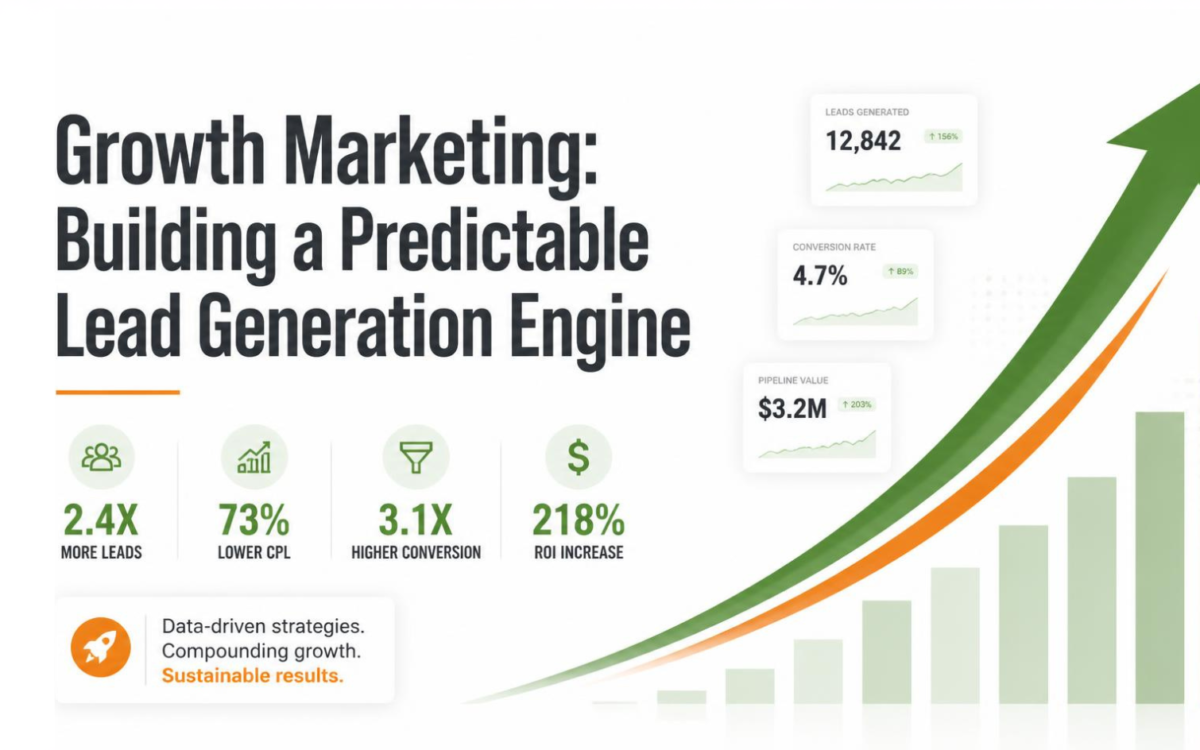
Operational siloes destroy campaign performance. Disconnected marketing workflows trigger acquisition hurdles that inflate expenditures. Growth Marketing Services resolve these systemic obstacles through unified, full-funnel optimization. Partnering with a specialized Growth marketing agency enables organizations to scale systematically while eliminating capital inefficiency.
Deploying a structured Growth marketing strategy establishes an end-to-end framework that connects top-of-funnel customer reach with bottom-of-funnel conversion. This methodology resolves revenue volatility for founders across the United States and Australia. Fragmented single-channel campaigns fail to sustain pipeline growth. Digital Marketers India constructs robust execution models that convert audience engagement into measurable sales opportunities.
What Is Growth Marketing?
Data-Driven Full-Funnel Optimization
What is growth marketing when evaluated from an operational standpoint? It represents a data-driven system focused on optimizing every stage of the customer lifecycle. Rather than running isolated promotional campaigns, this framework continuously evaluates user acquisition, onboarding, and customer retention metrics.
Accordingly, this iterative testing methodology eliminates wasted media spend. Traditional promotional efforts deploy static campaigns for months before analyzing performance reports. Conversely, an AI growth marketing agency executes rapid weekly test cycles to validate hypotheses, eliminate underperforming channels, and reallocate capital into high-converting assets.
Comprehensive Lifecycle Management
Modern customer acquisition requires complete lifecycle management. B2B growth marketing systematically optimizes five distinct operational stages:
- Awareness: Attracting ideal buyers through educational search assets.
- Acquisition: Capturing prospect contact data via intent-based offers.
- Activation: Converting prospects into qualified sales opportunities.
- Retention: Reducing churn through targeted lifecycle communication.
- Expansion: Driving account growth through upsells and referrals.
Furthermore, optimizing these stages creates a compounding acquisition engine. Aligning acquisition messaging with sales qualification logic improves long-term customer values.
Growth Marketing vs Digital Marketing vs Demand Generation vs Lead Generation
Strategic Distinctions Across Methodologies
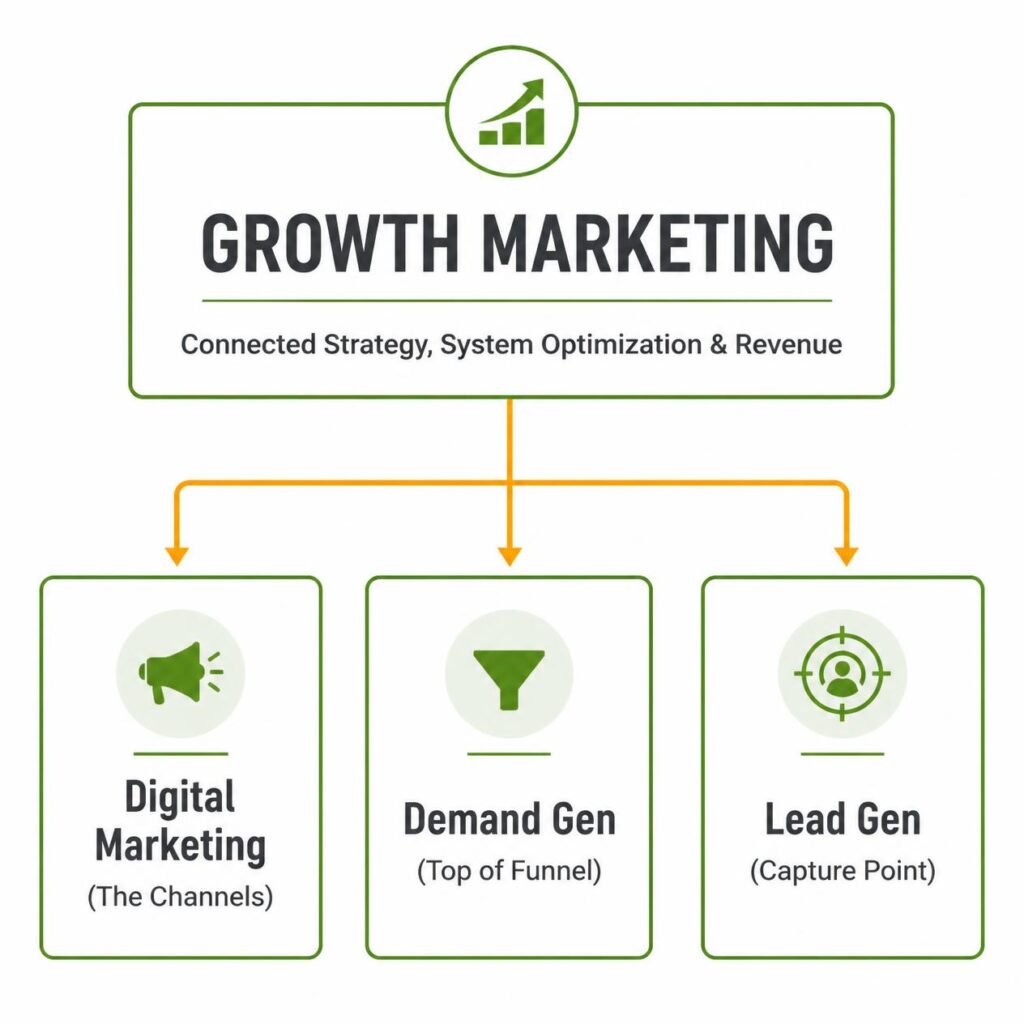
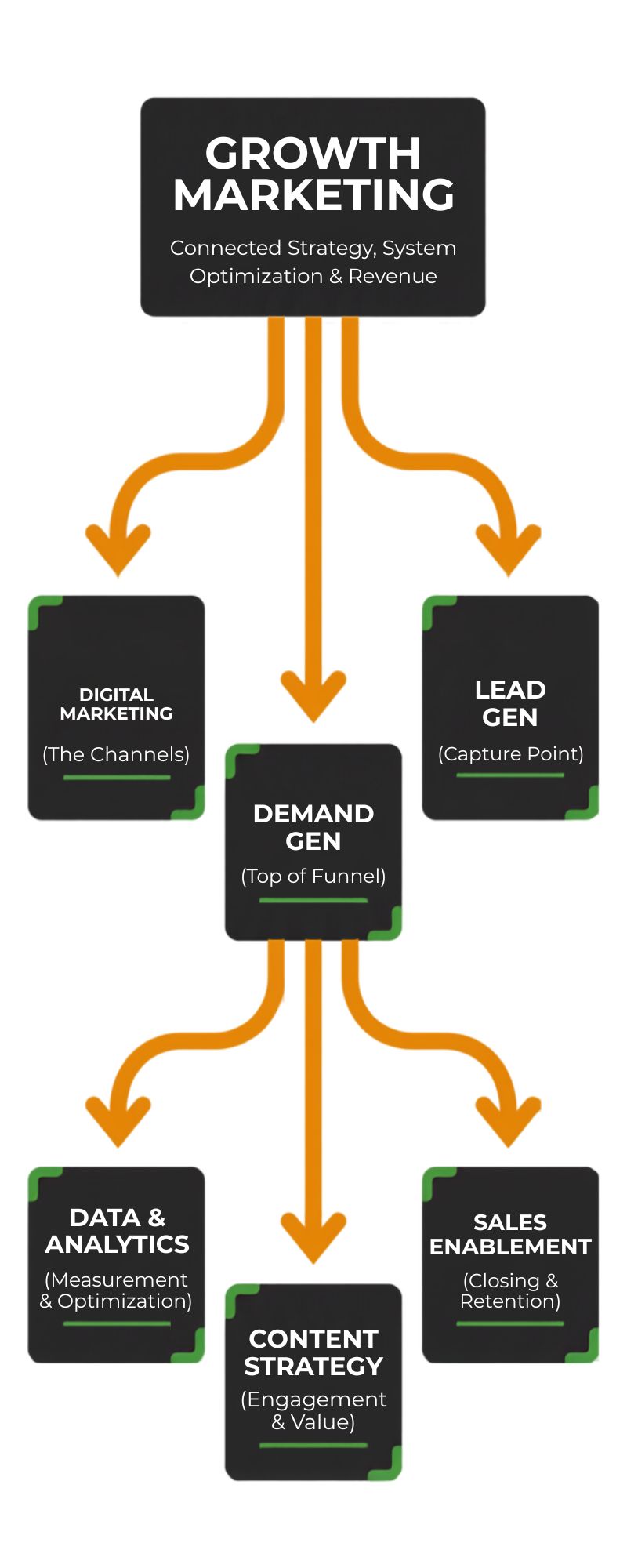
Understanding operational boundaries prevents resource misallocation. Digital marketing serves as an umbrella term for web-based communications platforms. Comparing Growth marketing vs digital marketing reveals that digital marketing defines the channel medium, whereas Growth marketing for lead generation provides the scientific optimization framework.
For example, an Australian technology consultancy runs search advertisements and active social channels independently. Under traditional digital marketing, channels report vanity metrics in isolation. Conversely, applying Growth marketing routes all traffic into unified, high-converting content clusters with automated qualification scoring. Consequently, total acquisition costs drop while qualified pipeline expands.
Similarly, evaluating Growth marketing vs demand generation shows that demand generation functions as an initial top-of-funnel lever. Demand generation builds category awareness among potential buyers. However, Growth marketing ensures that early buyer interest systematically converts into closed revenue. Demand generation fits new category creation. Growth marketing applies when teams must connect top-of-funnel education directly to pipeline generation.
Finally, comparing Growth marketing vs lead generation clarifies tactical capture versus full-funnel strategy. Standalone Lead generation services collect contact credentials via gated forms. B2B lead generation services acquire contact lists, whereas Growth marketing nurtures those prospects into multi-year enterprise accounts. Standalone lead capture suits simple, single-offer transactions. Growth marketing strategy remains necessary for complex sales cycles involving enterprise buying committees.
| Marketing Category | Primary Focus | Core Performance Metric | Ideal Application |
| Digital Marketing | Channel management and execution | Impressions, Click-through rates |
Establishing baseline digital presence across web channels. |
| Demand Generation | Category interest and brand awareness | Brand reach, Content engagement |
Educating prospective buyers on emerging market challenges. |
| Lead Generation | Prospect contact credential capture | Form submissions, Gated downloads |
Collecting targeted contact details for outbound sales teams. |
| Growth Marketing | Full-funnel revenue loop optimization | Pipeline value, CAC, Customer LTV |
Unifying all acquisition channels to build predictable revenue. |
How Does Growth Marketing Work?
Step 1: ICP and Messaging Alignment
Targeting precision precedes campaign deployment. Organizations must clearly define ideal buyer criteria before committing media spend. Value propositions must address acute customer pain points, operational friction, and competitive differentiators.
Step 2: Channel-Market Fit Testing
Controlled testing prevents capital depletion. Instead of launching campaigns across ten ad platforms simultaneously, teams conduct small experiments across select channels. Testing search engine optimization, outbound outreach, and paid channels identifies where prospects convert efficiently.
Step 3: Full-Funnel Attribution Tracking
Data integration connects initial buyer engagement with closed revenue. Implementing full-funnel lead generation tracking eliminates guesswork, granting executives visibility into channel performance. Both marketing and sales teams operate from unified data dashboards.
Step 4: Cross-Funnel Conversion Rate Optimization
Systematic optimization requires analyzing every customer touchpoint. Improving conversion performance across ad copy, landing page forms, sales calls, and contract steps drives revenue growth. Minor improvements at each funnel stage compound significantly.
Step 5: Account Retention and Expansion Loops
Sustainable business growth relies on maximizing customer lifetime value. Targeted onboarding sequences, automated retention messaging, and cross-sell programs lower acquisition costs while increasing net dollar retention.
Key Challenges in Growth Marketing (And Insightful Solutions)
Rising Acquisition Costs and Diluted Quality
Chasing raw lead volume inflates customer acquisition costs. Industry metrics indicate median B2B acquisition costs reached $213, with top-quartile programs achieving $84 per lead compared to $397 among bottom-quartile performers.
Accordingly, high-performing organizations implement conditional forms and automated CRM lead scoring. Qualifying prospects before sales routing ensures account executives focus on high-intent opportunities, decreasing wasted follow-up time.
Disconnected Channel Architecture
Managing search campaigns, paid media, and cold outreach in operational silos creates tracking gaps. Fragmented tech stacks prevent leaders from determining true acquisition sources.
Deploying multi-touch attribution dashboards provides clear visibility across all touchpoints. Connecting platform analytics with CRM data allows marketers to optimize spend based on closed revenue rather than click volume.
Misaligned Sales and Marketing Metrics
Marketing departments frequently measure success by form submissions, whereas sales teams focus on closed revenue. This disconnect produces operational friction and unserviced leads.
Establishing shared pipeline targets resolves inter-departmental friction. Formalizing Service Level Agreements (SLAs) defines explicit handoff criteria, ensuring complete alignment across the revenue loop.
Expanding Enterprise Buying Committees
Directing outreach to a single decision-maker ignores modern corporate buying realities. Research demonstrates the median B2B buying committee includes 11.2 decision-makers for enterprise purchases.
To solve this challenge, teams build multi-persona nurture tracks tailored to executives, technical evaluators, and end-users. Delivering role-specific content addresses individual stakeholder priorities simultaneously.
Mistakes Businesses Make in Growth Marketing
Quantity Over Audience Fit
Prioritizing lead volume over buyer profile fit burdens sales teams with unqualified contacts. Inundating sales reps with poor leads lowers overall conversion velocity.
Premature Scaling Without Attribution
Increasing campaign spend without reliable attribution models creates ad budget waste. Scaling unverified channels obscures true acquisition metrics.
Generic Content Production
Publishing high volumes of generic articles without funnel intent fails to engage decision-makers. Content must directly address specific buyer research stages.
Single-Persona Communication Tracks
Relying on single-contact email sequences ignores the multi-stakeholder approval process. Failing to nurture secondary decision-makers stalls enterprise deals.
Hiring Tactical Execution Teams Prematurely
Onboarding channel specialists before establishing a coherent growth strategy results in disjointed messaging. Strategy must precede channel execution.
Practical Steps to Build a Predictable Lead Generation Engine
Step 1: Implement Multi-Touch Attribution Infrastructure
Establish unified tracking across analytics tools, ad managers, and CRM systems before scaling media spend. Accurate attribution ensures capital connects directly to closed sales.
Step 2: Build Integrated Educational Content Assets
Construct comprehensive content clusters tailored for Search Engine Optimization (SEO), Answer Engine Optimization (AEO), and Generative Engine Optimization (GEO). Educational assets should be repurposed across search engines, sales enablement collateral, and outreach campaigns.
Step 3: Concentrate Capital on High-Leverage Channels
Identify primary platforms where ideal buyers actively research solutions. B2B organizations often achieve higher conversion efficiency through LinkedIn outreach and targeted search than consumer social platforms.
Step 4: Embed Interactive Qualification Forms
Integrate conditional form fields and custom qualification questions directly on landing pages. Filtering bad-fit prospects early preserves sales bandwidth and improves meeting conversion rates.
Step 5: Automate CRM Routing and Response Workflows
Configure automated workflows to instantly route leads based on company size, industry, or geography. Instant CRM alerts eliminate response delays, increasing contact rates.
Step 6: Test Dynamic Formats and Conversion Assets
Evaluate dynamic assets, video overviews, and interactive tools against static downloadable whitepapers. Interactive formats generate higher engagement and form conversion rates.
What Is a Growth Marketing Agency? (In-House vs. Fractional CMO)
Defining Agency Scope and Capabilities
What is a growth marketing agency and how does it integrate into existing operations? A growth partner manages the full acquisition-to-revenue engine: channel testing, campaign execution, attribution tracking, and continuous optimization. Organizations evaluating execution options typically compare two primary leadership formats:
Operational Focus Comparisons
In-house growth specialists focus on daily campaign deployment, creative variation testing, and channel monitoring. They suit companies possessing established strategy that require execution bandwidth.
Conversely, Fractional CMO leadership delivers high-level strategic direction without executive overhead. Fractional executives align sales and marketing teams, set channel budgets, and establish pipeline targets.
Furthermore, partnering with a specialized B2B growth marketing agency provides both strategic guidance and multi-channel execution capabilities simultaneously. This model grants access to senior strategy and specialized execution without internal team costs.
Actionable Takeaways
- Establish multi-touch attribution across all channels before increasing media spend.
- Build educational content clusters optimized for search engines and generative AI tools.
- Create multi-persona nurture sequences targeting enterprise buying committees.
- Formalize explicit lead qualification criteria through shared sales and marketing SLAs.
- Configure automated CRM lead routing to ensure instant sales follow-up.
Frequently Asked Questions
What is growth marketing?
Growth marketing is an end-to-end framework focused on optimizing the entire customer lifecycle. It uses rapid testing across acquisition, activation, conversion, and retention to drive predictable revenue.
Growth marketing vs digital marketing: What is the key difference?
Digital marketing defines the digital platforms used for promotion. Growth marketing provides the data-driven framework that optimizes those channels to maximize revenue.
Growth marketing vs demand generation: How do they compare?
Demand generation focuses on building top-of-funnel category awareness. Growth marketing is the broader system that captures that audience interest and converts it into a qualified sales pipeline.
How does growth marketing work?
Growth marketing operates through continuous testing loops across five stages: ideal customer profile definition, channel testing, attribution tracking, conversion rate optimization, and account retention.
What is a growth marketing agency?
A growth marketing agency designs, executes, and optimizes complete customer acquisition engines. They manage full-funnel strategy, campaign deployment, and analytics optimization.
Strategic Execution with Digital Marketers India
As Peter Drucker famously stated, “What gets measured gets managed.” Building a predictable acquisition engine requires unifying top-of-funnel reach, mid-funnel conversion, and long-term client retention into a connected system. Digital Marketers India delivers white-label execution frameworks for agencies, consultants, and marketing leaders across Australia, the United States, and the United Kingdom.
Our team translates growth strategy into flawless execution. We build tailored messaging frameworks, deploy multi-channel search and ad campaigns, construct GoHighLevel CRM workflows, and produce content clusters optimized for SEO, AEO, and GEO. Furthermore, we operate quietly behind your brand as an invisible white-label execution partner, enabling you to scale capacity without expanding internal overhead. At Digital Marketers India, we recently helped a client connect outbound campaign workflows into a unified CRM pipeline with automated scoring, cutting follow-up time by 50% while expanding qualified demos.
We offer lifetime locked-in execution rates to innovative business ideas, startups, and SMBs. Gain a competitive execution advantage today by scheduling a strategic consultation at Digital Marketers India Services before Founding Member allocations close.
|