


For the first time, Google has announced an upcoming algorithm update and given sufficient time to get ready for that. This blog post will give all the information to be prepared for the upcoming major algorithm update.
You will learn about everything related to upcoming major ranking algorithm updates on Google to get prepared for the same.
About Upcoming Major Google Update:
- What Google Announced Today?
- What Are Google Core Web Vitals?
- Decoding Upcoming Google Algorithm Update
- What Can You Do to Get Prepared?
- When Will It Be Live?
- Google Tools to Enhance User Experience Factors
- Is There Any Cache?
- Final SEO Tips
Google is coming up with the new major algo update soon. There is no official name given, but some renowned SEO news sites have given it the name “Google User Experience Update”.
Let’s delve deeper to know more about this upcoming major change, which will definitely change the SEO plans of many, especially, best SEO companies.
1. What Google Announced Today?
Google announced that it will launch the next Google update (means the next major Google Algorithm update will be launched). This algorithm will be highly focused on user experience delivered to the visitors on the website.
It means if your website (or webpage) cannot deliver a good user experience, then your website (or webpage) will not rank higher. If it is already ranking on the top positions, then it will stumble if you fail to meet the best user experience criteria.
Google has also shared clear information (surprisingly, this time in advance) to help webmasters to get prepared for this upcoming major Google Algorithm update.
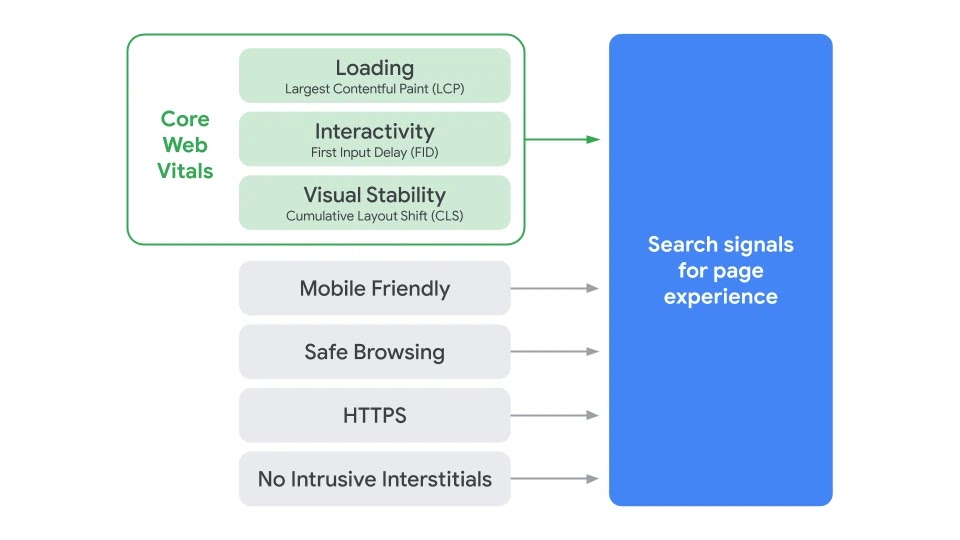
All signals shown in the above-mentioned image are related to user experience. The Core Web Vitals (highlighted in green and shown in the block) are newly introduced and will also heavily influence both, user experience and website rankings. The remaining signals were there for some time and followed by almost all SEO experts. Still, we will delve deeper into all the above-mentioned signals in this blog post to get a clear and better understanding of these ranking signals.
2. What Are Google Core Web Vitals?
Google has defined three important components related to user experience, which are named as, Google Core Web Vitals.
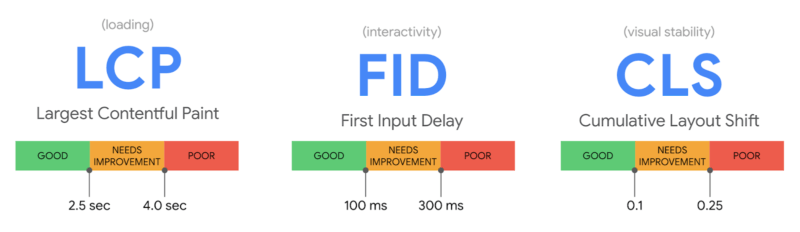
Largest Contentful Paint (LCP): It measures the website loading performance. Ideally, LCP should occur within 2.5 seconds to score well. If it occurs after 4.0 seconds, then your website is in poor condition and more likely to lose top positions.
First Input Delay (FID): It measures interactivity, which means users can quickly interact with the site and get expected results without major delays. To excel here, FID should be less than 100 milliseconds. If it is more than 300 milliseconds, you are more likely to lose the game.
Cumulative Layout Shift (CLS): It measures how stable your elements are on the webpage and it does not shift while loading other content. It should be less than 0.1. This is often a major concern for users as they mistakenly click the wrong element just because content loading on the webpage shifts other content and components. Google gave a nice example of this factor in an image format for better understanding. Check this.
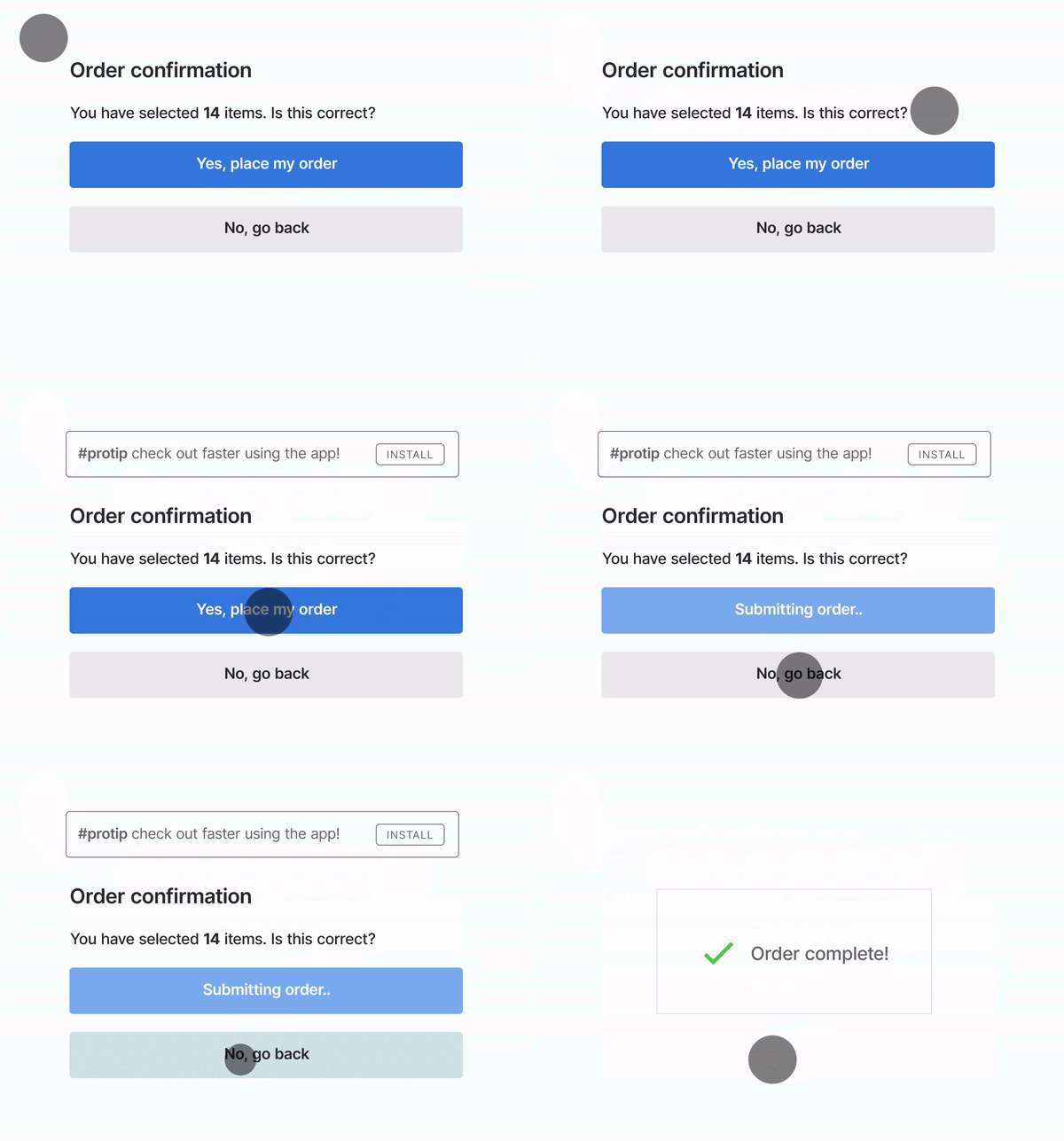
As shown in the example, the customer did not want to place an order, but as content load shifted buttons, he clicked on the wrong button and placed the order.
3. Decoding Upcoming Google Algorithm Update
Google has cleared its intentions that User Experience will be considered as one of the deciding factors to rank webpages in the SERP (Search Engine Result Pages). If we decode the shared information by Google, webmasters need to optimize their website to deliver a great user experience. Of course, they have to apply all other best SEO practices, plus, they need to optimize their website for the following factors which will contribute in ranking a website on the top positions by delivering a good user experience:
- Largest Contentful Paint (LCP): It defines how quickly webpage loads.
- First Input Delay (FID): It defines how fast interaction happens.
- Cumulative Layout Shift (CLS): It defines whether content elements shift as other elements and content load gradually.
- Mobile-friendliness: It checks whether a website is mobile-friendly aka responsive or not.
- Safe browsing: It checks whether the website is safe without having any malicious content, malware, etc.
- HTTPS: It assures whether a site has an SSL certificate or not.
- No intrusive interstitials: It assures there is no disturbing content, which adversely affects the user experience, such as ads at the beginning of the webpage.
4. What Can You Do to Get Prepared?
Google has made its intentions clear that it will give user experience priority to rank websites, and why not? It is a useful factor, not only for Google to deliver better results to its searchers, but also for webmasters. For example, if your website does not deliver the required user experience, it is possible that visitors come and bounce back (leave the site), without taking any action. This type of website traffic is of no use. Thus, it is advisable to work on delivering a good user experience, not only to rank higher, but also to achieve business goals such as increased lead generation, increased newsletter subscribers, and more.
Now, the question is how you can get prepared for this upcoming Google update. If you are using the best SEO marketing services from a reliable digital marketing company, then you do not need to worry about it, they will do the needful. However, if you are working on the SEO of your own website or learning SEO, then here are the top tips you should be following:
- Largest Contentful Paint (LCP): You should work to optimize the website load speed. You can also use Page speed tools to check the speed of individual pages with suggestions to improve its speed and load your site faster.
- First Input Delay (FID): Thoroughly review your website, you can also put it for quality assurance and identify the areas where the FID score is bad. You need to improve those parts.
- Cumulative Layout Shift (CLS): Your website should not shift sections while other content or elements are loading. Here as well, testing and optimization are useful. Webpages need to be more stable.
- Mobile-friendliness: Your website has to be responsive and it must deliver the same experience on any device to users. Nowadays, more and more people browse websites from their smartphones aka mobile devices. Thus, it has to be mobile-friendly. People should not see the cluttered design and overlapped elements if they explore the website on different devices. Thus, you need to invest in responsive web development, if your website is not already responsive.
- Safe browsing: Your website should not have any malware or malicious content. Of course, you would not be putting it knowingly, but, you need to keep eyes on your site to make sure such unsafe content does not get injected into your site by hackers. If there is any, you need to invest in removing them at the earliest possible.
- HTTPS: This is one of the ranking factors already introduced by Google in the past. Your website must have an SSL certificate. In simpler words, the web URLs of your website should start with https:// instead of http://. If you do not have an SSL certificate already, then you will need to install it and redirect all your old URLs with http:// to the new with https:// via 301 redirection.
- No intrusive interstitials: If you are a service or product selling company, it is advisable to avoid using ads in your company or product website. You better give up some bucks earned from Adsense or similar ad sites. If ads are the only way to earn revenue for your site, then you need to put ads in a way that it does not affect the user experience negatively. For example, do not put ads at the beginning of the page.
As you can see, to optimize all of these factors, SEO professionals will need the help of website developers as a majority of these factors are related to website optimization.
5. When Will It Be Live?
One of the interesting facts about this upcoming Google algorithm update is that webmasters are informed well in advance. This algorithm update will be live in 2021. There is no fixed date or month announced yet, but it will be rolled out as early as possible. It means everyone has almost six months to optimize the website and get ready to take advantage of this algorithm update.
6. SEO Tools to Enhance User Experience Factors
There are multiple SEO tools available in the market, which can be used to analyze the website for all given SEO criteria and then optimize the same. Here is the list of best SEO tools available for free and offered by Google itself:
- Lighthouse
- PageSpeed Insights
- Search Console
- Web Vitals Extension
- Chrome DevTools
- Chrome UX Report
7. Is There Any Cache?
Nothing is that straightforward in Google, then how can it be this time? There is a cache in this upcoming algorithm change as well.
Content will be the king.
After reading this SEO blog post, you might be thinking, this Google algorithm will focus more on user experience. Thus, you might be assuming that great user experience will be the key deciding factor to rank higher.
Wait a minute!
Google will still consider other ranking factors such as content, Link juice, etc. and user experience will be ultimately one of the major ranking factors. Thus, while working on your website optimization to deliver better user experience, you better not forget to work on other factors as well to achieve and retain top positions.
One of the major contributors to top rankings is great content. Google has shared that even if a site does not deliver outstanding user experience, but it has great content to offer, then that site will rank on the top position. Yes, you guessed it right, along with the website optimization to deliver exceptional user experience, you will also need to get SEO content writing from an experienced company like us. You will also need to work to perform well at other ranking signals’ criteria.
8. Final SEO Tips
Time to conclude the long story short.
In 2021, Google will release its one of the major algorithm updates and this update will be more leaned towards better user experience. Thus, it is vital that everyone optimizes their websites to deliver a better user experience. Improving a website to deliver a better user experience will not only help in securing the top ranks in Google, but it will also help in achieving other business goals such as increased lead generation, better sales, improved readership, increased subscribers, and more.
Hope these tips and guide will help you grab this opportunity. If you need help from experts for website optimization and/or for its SEO marketing, contact us.